The “Grinding” Trap
Walk into any traditional steel structure workshop, and you hear it: the deafening scream of angle grinders. You see it: clouds of metal dust and workers hunched over heavy steel plates, manually grinding flame-cut edges.
It looks like hard work. But in 2026, it’s just wasted money.
For decades, fabricators accepted that preparing plate edges meant either:
- Flame/Plasma Cutting: Fast, but leaves a messy edge with a Heat Affected Zone (HAZ) that must be ground off.
- Manual Grinding: Slow, inconsistent, and a massive health & safety liability.
Enter Plate Edge Milling.
Imagine a machine that clamps onto the edge of your plate, travels automatically along the length, and shears the metal off in quiet, cold chips—leaving a mirror-finish surface at exactly 45°. No dust. No noise. No heat.
This guide explains why shifting to Cold Milling is the biggest efficiency upgrade you can make this year.
The “Physics” of Plate Beveling: Milling vs. Thermal Cutting
The biggest misconception in plate processing is that “a bevel is just a bevel.” It’s not. How you make the bevel determines how well it welds.
| Method | Edge Quality | HAZ (Heat Affected Zone) | Secondary Process? | Speed |
|---|---|---|---|---|
| Flame/Plasma | Rough / Oxidized | Severe (Hardened edge) | YES (Must grind off oxide/HAZ) | Fast Cut, Slow Prep |
| Manual Grinding | Inconsistent | High (Friction heat) | No | Painfully Slow |
| Edge Milling (Cold) | Mirror Finish | Zero (Cold Cutting) | NO (Ready to weld) | Fast & Consistent |
The metallurgy matters: If you weld directly over a flame-cut surface (HAZ), you risk cracking. If you use a Milling Machine (like our GL Plate Beveler Series), you are welding on virgin base metal.
My stance: If you’re still grinding flame-cut edges in 2026, you’re not just wasting labor—you’re creating an unsafe work environment. OSHA and HSE inspectors are increasingly cracking down on metal dust exposure.
Plate Bevel Types: It’s Not Just “V” Anymore
In pipe, you are limited to single-sided access. In plate, you often have access to both sides, which opens up the most efficient joint designs: K-Groove and X-Groove.
 Left to right: V-Groove, Y-Groove, X-Groove (Double-V), K-Groove
1. V / Y Groove (Single Sided)
Best for: Thinner plates (< 20mm)
The Machine: A standard auto-walking milling machine runs along the top edge once. Done.
My advice: For plates under 20mm, don’t overthink it. V-groove is simple, fast, and gets the job done.
2. X-Groove / Double-V (The Efficiency King)
Best for: Thick plates (> 25mm)
Why? Instead of cutting a massive V on one side (which consumes huge amounts of filler), you cut two smaller V’s on top and bottom.
Benefits:
- Reduces filler metal by 50%
- Balances welding stress to prevent the plate from warping (“butterflying”)
- Faster welding: two smaller welds are faster than one massive weld
The Machine: You need a machine that can mill the bottom side without flipping the heavy plate (like our DMM-90X or DMM-900X Series).
My experience: Every time I see a fabricator struggling with plate distortion on thick welds, they’re using single-sided V. Switch to X-Groove and the problem disappears.
3. K-Groove (For T-Joints)
Best for: Welding a vertical web to a horizontal flange (Steel structures/Beams)
Challenge: Requires a strictly controlled “Land” (Root face) to ensure the vertical plate sits 90° perfectly. Milling machines guarantee this precision; hand grinding cannot.
→ DMM-1232 Series - Precision land control for perfect T-joint preparation
The Game Changer: Self-Propelled Automation
The single biggest difference between Pipe and Plate machines is Mobility.
- Pipe Machines are stationary or clamped on the pipe.
- Plate Machines (Milling) are Self-Propelled Robots.
You don’t push the machine. You set the angle, engage the drive, and the machine “walks” along the plate edge automatically.
The ROI multiplier: One operator can manage 3 running machines simultaneously.
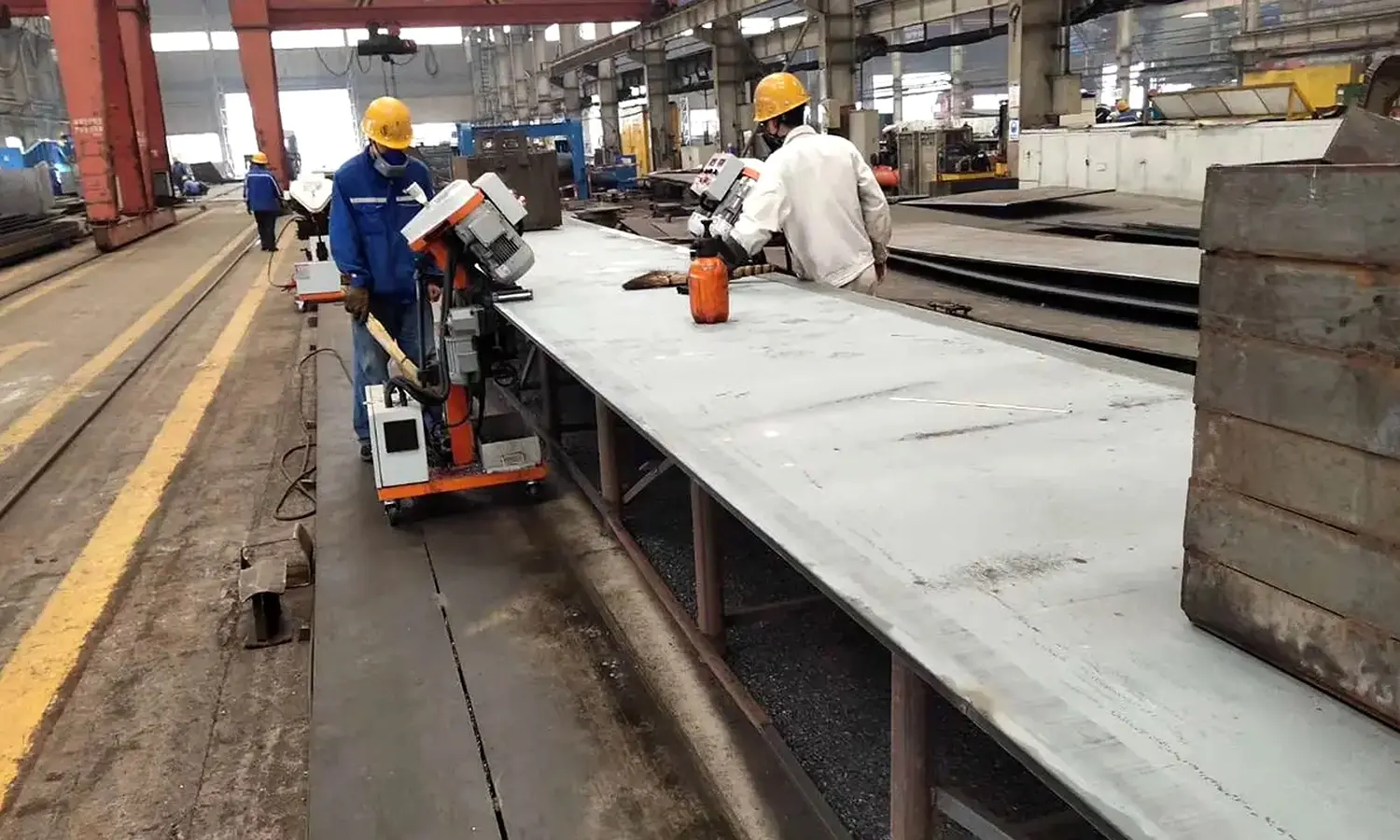 GL Series auto-walking along a 12m plate edge
My observation: The shops that adopted self-propelled bevelers 5 years ago are now running circles around competitors still using grinders. It’s not even close.
Real Case: The Bridge Builder
A customer manufacturing bridge girders was using 4 workers with grinders to prep 12-meter long plates. It took them 2 hours per plate.
I asked: “What’s your cost per meter of bevel prep?”
They didn’t know. Nobody had calculated it.
Switch: They bought one GL Plate Beveler.
Result: The machine milled the entire 12m length in 20 minutes.
| Metric | Manual Grinding | GL Edge Milling | Improvement |
|---|---|---|---|
| Time per 12m plate | 2 hours | 20 minutes | 83% faster |
| Workers required | 4 | 1 | 75% less labor |
| Edge consistency | Variable (±3°) | Perfect (±0.5°) | Welding robot compatible |
| Metal dust exposure | High | Zero | HSE compliance |
The kicker: The consistent bevel angle made the automatic welding robot’s job flawless. Before, the robot had to compensate for grinding inconsistencies. After, it ran at full speed.
ROI: The labor cost dropped by 90%. Machine paid for itself in 4 months.
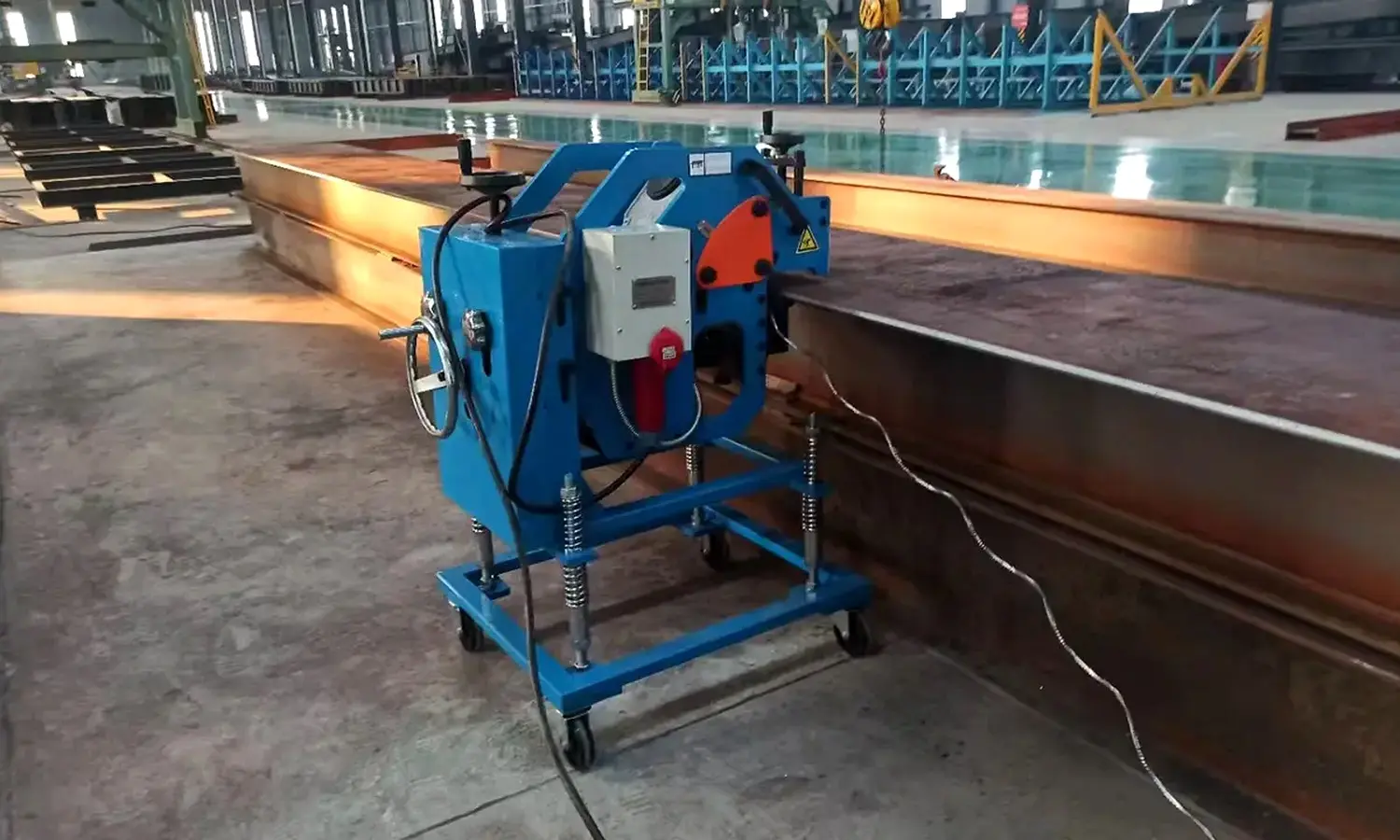 GL Series edge milling machine working on bridge girder plates
Equipment Selection Guide
Don’t overbuy. Plate milling falls into three categories:
For Curved Plates & Irregular Pieces
Scenario: You have curved plates, holes to bevel, or small irregular pieces.
Solution: Handheld Milling
→ SKF-15 Handheld - Portable, lightweight, goes where big machines can’t. Perfect for curves and holes.
My advice: Every plate shop needs at least one handheld beveler. It’s your “Swiss Army knife” for the jobs that big machines can’t reach.
For Long Straight Plates (Standard Duty)
Scenario: You have long straight plates, standard V or Y grooves.
Solution: Auto-Walking Edge Milling
→ GL Plate Beveler Series - The industry standard. Clamps to the edge, walks automatically. Covers V, Y grooves.
For Heavy Plates & Double-Sided Bevels
Scenario: You have HUGE plates and need X-Groove / K-Groove / Double-V bevels.
Solution: Heavy-Duty Edge Milling Machine
→ DMM-90X Series - 180° flip capability. Can mill the underside without flipping the plate (huge safety & time saver).
→ DMM-900X Series - For the heaviest industrial applications.
→ DMM-1232 Series - Maximum capacity for shipbuilding and heavy structure.
For High-Volume Production
Scenario: You need stationary, production-line beveling.
Solution: Benchtop/Stationary Milling
→ DZ Benchtop Series - Fixed installation, consistent output for production environments.
| Your Scenario | Recommended Solution | Why |
|---|---|---|
| Curved plates, irregular pieces | SKF-15 Handheld | Portable, flexible, handles curves |
| Long straight plates (< 25mm) | GL Plate Beveler | Auto-walking, industry standard |
| Thick plates, X-Groove / K-Groove | DMM-90X | 180° flip, double-sided capability |
| Maximum capacity (shipbuilding) | DMM-1232 | Heavy-duty, precision land control |
| Production line, high volume | DZ Benchtop | Stationary, consistent output |
Summary: Efficiency is a Choice
The era of manual grinding for heavy plate is over. It’s too slow, too dirty, and too expensive.
- Stop Grinding: It’s a bottleneck.
- Start Milling: It’s a process accelerator.
- Think Double-Sided: Use X-Grooves on thick plates to save 50% on welding costs.
- Automate: One operator, three machines. That’s the future.
Ready to Ditch the Grinders?
Tell me:
- Plate thickness range
- Material type (Carbon Steel, Stainless, Hardox?)
- Typical plate length
I’ll recommend the right Walking Speed and Cutter Head configuration to double your prep efficiency.
→ Browse All Plate Beveling Machines → Pipe Bevel Types Guide (Related Reading)
Need the Right Equipment?
Our team can help you choose the best pipe beveling solution for your specific requirements.
Get Expert Advice